Predicting inheritance
Use parental alleles to predict possible offspring genotypes and their probabilities.
Read the allele symbols
A gene is a section of DNA involved in a characteristic. An allele is a version of a gene. Genotype means the alleles an organism has; phenotype means the features it shows.
In a simple dominant–recessive model, one dominant allele is enough to show the dominant feature. Two recessive alleles are needed to show the recessive feature. This model does not describe every characteristic.
Combine the gametes
Gametes are sex cells. Each receives one allele of the gene in this model. A Punnett square combines one gamete from each parent to list possible offspring genotypes.
Homozygous means two matching alleles, such as AA or aa. Heterozygous means two different alleles, such as Aa. Probabilities describe chances, not a guaranteed order of births. State the parental genotypes and assumptions.
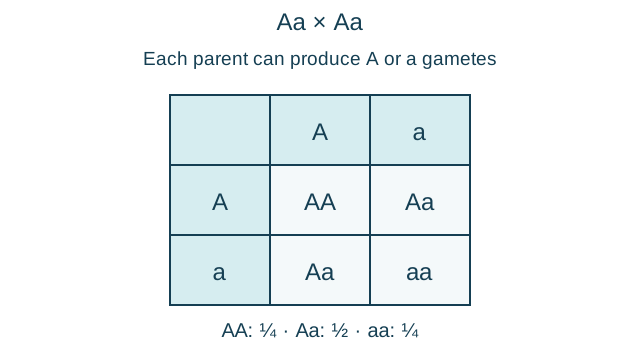
Scroll sideways to see the whole diagram.
Worked example
For Aa × Aa, the four combinations are AA, Aa, Aa and aa. The chance of aa is 1 in 4, or 25%. This does not mean every fourth offspring will be aa.
Read the detailed explanation
A genetic cross is a probability model. It connects the alleles in parental cells to possible gametes and offspring, but its predictions depend on clear assumptions about the gene and the relationship between genotype and phenotype.
Track alleles through gametes
A gene is a section of DNA that contributes to a functional product. Alleles are versions of a gene. For a typical autosomal gene, a diploid individual has two alleles, one inherited from each parent. Gametes carry one allele of that gene, and fertilisation restores a pair.
Genotype describes the alleles present. Phenotype is the observable characteristic, influenced by genotype and sometimes environment. Homozygous means the two alleles are the same; heterozygous means they differ. Capital and lower-case letters in a simple cross are symbols for alleles, not separate genes or measures of importance.
State the dominance model
In a complete-dominance model, the heterozygote has the phenotype associated with the dominant allele. A recessive phenotype appears in the homozygous recessive genotype. Dominant does not mean more common, stronger or better. The frequency of an allele in a population is a separate question.
For a recessive condition, a heterozygous individual may be described as a carrier. This description depends on the stated model. It does not imply that every inherited condition is recessive, that carriers always lack every effect, or that a particular genotype determines every feature of health.
Interpret a predicted proportion
Write each possible gamete, then combine one from each parent. If the gamete types are equally probable, the boxes in a genetic cross are equally likely outcomes. Count the boxes for the requested genotype or phenotype and divide by the total. Separate genotype categories before combining those that share a phenotype.
Each fertilisation is independent in this simplified model. One recessive offspring does not use up recessive alleles or change the next probability. Expected count equals number of offspring multiplied by probability, but actual counts can differ through chance. Small samples often differ visibly from the predicted proportions. Many characteristics involve several genes or environmental effects, so a single-gene cross must not be used without checking its assumptions.
Another worked example
For Aa × Aa, the possible combinations are AA, Aa, aA and aa. Aa and aA represent the same heterozygous genotype. The probability of aa is 1/4 = 25%. In 80 offspring the expected count is 20, but the model does not guarantee exactly 20.
Practical reasoning
- Define the allele symbols and the dominance relationship.
- Identify the parental genotypes and gametes.
- Combine one gamete from each parent and label all possible offspring genotypes.
- Calculate the requested probability and state that expected counts are predictions rather than guarantees.
Check your reasoning
- A dominant allele need not be the most frequent allele.
- A 25% probability does not mean every fourth offspring has the characteristic.
- A phenotype alone may not distinguish a dominant homozygote from a heterozygote.